
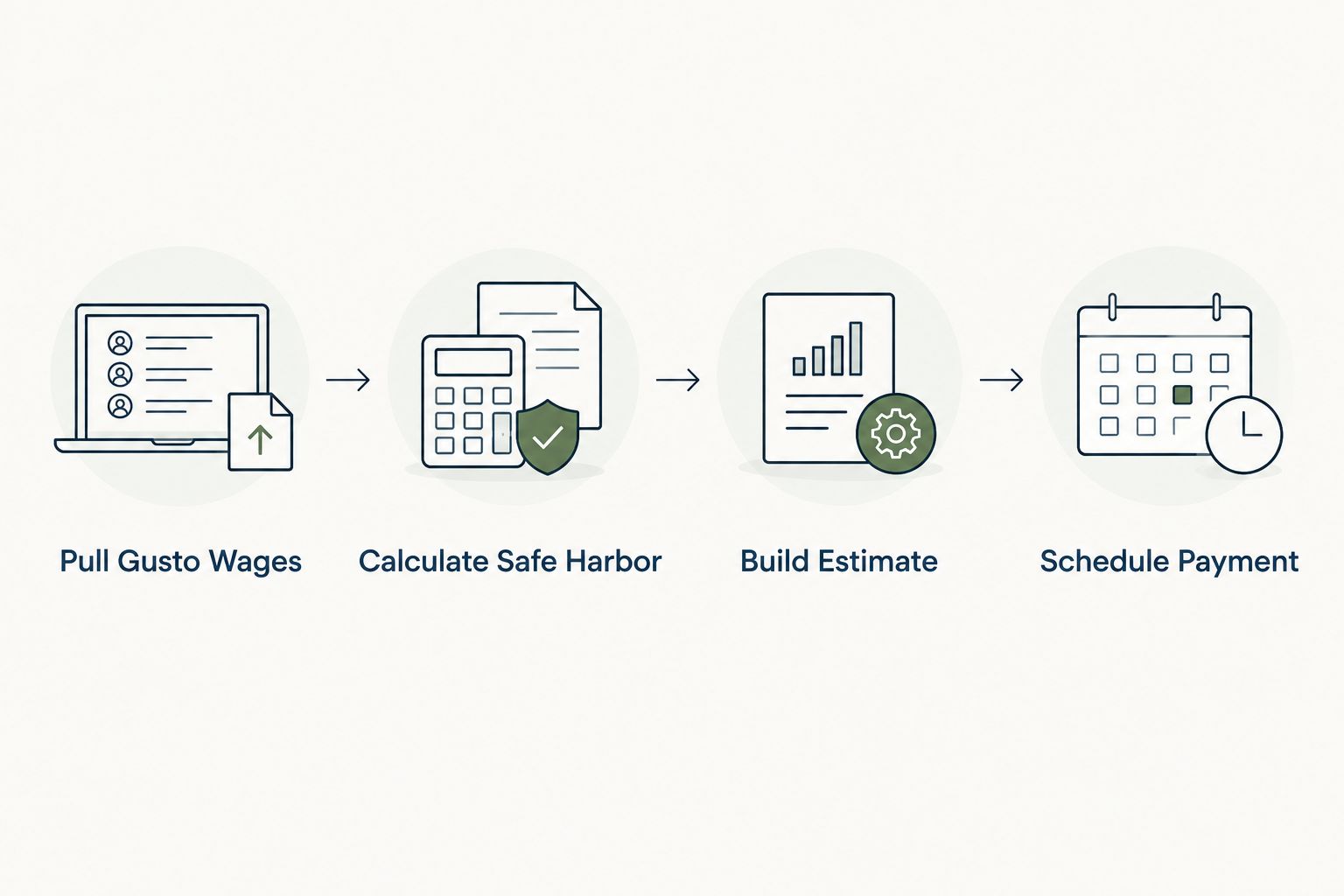
Pulling last quarter's Gusto payroll numbers by memory and guessing at your next 1040-ES check is how S-corp owners end up owing a Form 2210 penalty in April. Build a repeatable workflow instead: pull your exact year-to-date wages and federal withholding from Gusto, run them against your safe harbor number, and lock in a quarterly estimated tax payment before the deadline — not the night before it.
- Pull Gusto's Tax and Wage Summary before every quarterly estimate — the Payroll Journal report shows the wrong wage figure.
- Gusto quarterly estimated taxes for S-corp owners depend on W-2 withholding plus distributions, not net profit.
- Safe harbor at 110% of last year's total tax (100% if AGI is under $150,000) protects you from penalties even if 2026 income spikes.
- Run the calculation the week Gusto closes payroll for the quarter, never the week the 1040-ES is due.
Why this matters
An S-corp owner running payroll through Gusto has two income streams hitting one tax return: W-2 wages with federal withholding already taken out, and distributions with zero withholding taken out. The IRS doesn't care which bucket the money came from — it wants 100%-110% of last year's tax paid in on time, in four pieces, or it charges interest through Form 2210.
Most owners either overpay by padding every quarterly check out of fear, or underpay because they forgot the distribution they took in August had zero tax withheld against it. Elevated Tax Strategies sees the second mistake more often, and it's the more expensive one — a $40,000 fourth-quarter distribution with no withholding attached can turn a clean year into an underpayment penalty by itself.
Before you start
- Gusto admin access with reporting permissions. You need the Tax and Wage Summary report, not just your own pay stub view.
- Last year's Form 1040, line 22 (total tax). This is the number your 110% or 100% safe harbor target is built from.
- A running log of every distribution taken outside payroll, since Gusto only tracks W-2 wages and withholding — it has zero visibility into owner draws.
- The gotcha: Gusto's default Payroll Journal report shows gross wages before deductions. The number you actually need for the 1040-ES worksheet is on the Tax and Wage Summary report, which breaks out federal income tax withheld separately. Pull the wrong report and your estimate is off before you've started.
Pull your Gusto wage and withholding numbers
- In Gusto, go to Reports and select Tax and Wage Summary.
- Set the date range to January 1, 2026 through the last day of the quarter you're closing out.
- Filter to your own employee record if you're running payroll for multiple staff.
- Note two figures: Gross Wages (YTD) and Federal Income Tax Withheld (YTD).
- Cross-check against your last pay stub of the quarter — the YTD withholding line on the stub should match the report total.
Expected result: you have a clean YTD wage and withholding number that's already been paid to the IRS through payroll, with no guessing involved.
Calculate your safe harbor target
- Take last year's Form 1040, line 22 (total tax liability).
- Multiply by 110% if your prior-year adjusted gross income was over $150,000, or 100% if it was under $150,000.
- Divide that number by four to get your quarterly safe harbor payment.
- Subtract the federal withholding Gusto already took out for that quarter (from the step above) — that's already counted as paid.
- The remainder is what you owe through a direct 1040-ES payment.
Expected result: a single dollar figure per quarter that accounts for what Gusto already withheld, so you're not double-paying.
Build the quarterly estimate
- Add up any distributions taken during the quarter that had zero withholding.
- If distributions were large relative to your W-2 wage, re-check whether your reasonable compensation is still defensible — a widening gap between salary and distributions is the single most common trigger for IRS scrutiny on S-corps.
- Combine the safe harbor shortfall from the step above with any additional tax exposure from distribution income (capital gains, rental income, side 1099 work) that has no withholding against it at all.
- Total the number. This is your quarterly 1040-ES payment.
Expected result: one number, reconciled against Gusto's actual withholding, ready to schedule.
Schedule the payment
- Go to IRS Direct Pay or EFTPS and select 1040-ES as the payment type.
- Enter the tax year as 2026 and the correct quarter.
- Submit before the deadline: April 15, 2026 for Q1, June 15, 2026 for Q2, September 15, 2026 for Q3, and January 15, 2027 for Q4.
- Save the confirmation number in the same folder as your Gusto reports for that quarter.
Expected result: payment posted, penalty exposure closed for the quarter.
If you're still deciding on the payroll platform itself, Elevated Tax Strategies' comparison of payroll software built for S-corp owners covers which tools make this quarterly pull easier versus which ones bury the withholding number three reports deep.
Second variant: annualized income for lumpy years
If your S-corp income isn't even across the year — a real estate closing in Q3, a big contract that lands in Q4 — the flat quarterly safe harbor number can overstate what you owe early in the year. Use the annualized income installment method on Form 2210, Schedule AI instead. It lets you calculate each quarter's payment based on actual income earned through that point, not a flat quarter of your prior-year liability. It takes more paperwork, but it keeps cash in your business in Q1 and Q2 when income genuinely hasn't arrived yet.
Troubleshooting
- Gusto's YTD wages don't match your bookkeeping software. Reconcile at the source — Gusto is the authority on wages actually paid and withheld; your bookkeeping software may be recording accrual-basis payroll expense that doesn't match the cash-basis wage figure the IRS cares about.
- You raised your own salary mid-2026 and now Q1/Q2 estimates look too low. Recalculate the full-year safe harbor target using the new annualized wage, and true up the shortfall in the next quarter rather than waiting until Q4.
- A distribution came in bigger than planned in Q3. Treat it as unwithheld income immediately — don't wait for the annual return to discover the gap. Add it to the current quarter's 1040-ES payment.
- State withholding through Gusto doesn't match your state's own estimated tax system. Texas has no state income tax, but if you have nexus in a state that does, Gusto's payroll withholding for that state and your quarterly state estimate are two separate calculations — don't assume Gusto handles both.
- You hit safe harbor and still got a penalty notice. Check whether the payments were made on time and in the right amount each quarter — safe harbor protects the total, but the IRS's Form 2210 penalty calculation is applied per-quarter unless you use the annualized method.
Get your 2026 safe harbor number checked
A 20-minute review catches a missed distribution before the IRS does.
Customize your workflow
Once the quarterly pull from Gusto is running on autopilot, the next fix is usually officer compensation itself — if your W-2 salary hasn't been reviewed since you set it up, the QuickBooks to S-corp officer compensation compliance workflow walks through resetting it against current profit.
If you're taking distributions out of a Relay account rather than tracking them by hand in a spreadsheet, the Relay to automatic S-corp owner draw tracking workflow automates the distribution log this whole quarterly estimate depends on.
FAQ
How do quarterly estimated taxes work for an S-corp owner using Gusto?
Gusto withholds federal income tax on your W-2 wages automatically each pay period, but distributions carry no withholding at all. Quarterly estimated taxes cover the gap between what Gusto already withheld and your full safe harbor target for the quarter.
What is the 2026 safe harbor percentage for estimated taxes?
Pay in 110% of your 2025 total tax liability if your prior-year adjusted gross income was over $150,000, or 100% if it was under $150,000. Hitting that number in equal installments avoids a Form 2210 underpayment penalty regardless of how 2026 income turns out.
When are 2026 quarterly estimated tax payments due?
April 15, 2026 for Q1, June 15, 2026 for Q2, September 15, 2026 for Q3, and January 15, 2027 for Q4. Missing any one deadline can trigger a penalty for that quarter even if the full year ends up overpaid.
Which Gusto report shows the right wage number for the 1040-ES worksheet?
Use the Tax and Wage Summary report, not the Payroll Journal. The Payroll Journal shows gross wages before deductions, while the Tax and Wage Summary breaks out federal income tax withheld separately, which is the figure you subtract from your safe harbor target.
Do S-corp distributions count toward estimated tax payments?
Distributions have zero tax withheld against them, so they don't automatically satisfy any part of your estimated tax obligation. Every dollar of distribution income needs to be covered by an additional 1040-ES payment or a corresponding increase in payroll withholding.
What happens if I underpay my quarterly estimated taxes as an S-corp owner?
The IRS charges an underpayment penalty calculated on Form 2210, based on the federal short-term interest rate plus 3 percentage points, applied to each quarter you fell short. The penalty accrues quarter by quarter, so a shortfall in Q1 still costs you even if Q4 makes up the difference.
Can I use the annualized income method instead of flat quarterly payments?
Yes — Form 2210, Schedule AI lets you calculate each quarterly payment based on income actually earned by that point in the year rather than a flat quarter of last year's liability. It's the right tool when income is lumpy, like a real estate closing that lands in a single quarter.
Does raising my S-corp salary mid-year change my quarterly estimated tax payments?
Yes — a mid-year salary increase changes your annualized withholding total, which usually means your earlier quarterly estimates were calculated on the old, lower safe harbor number. Recalculate immediately and true up the difference in the next quarter rather than waiting for year-end.
One last thing
The single biggest miss in this whole workflow isn't the math — it's the timing. Owners who wait until the 1040-ES deadline to look at Gusto's numbers almost always find a distribution they forgot to account for. Pulling the Tax and Wage Summary the week the quarter closes, instead of the week the payment is due, is the entire difference between a clean 2026 and a Form 2210 penalty notice in 2027.