
Coinbase's tax documents cover a fraction of what the IRS wants to see. If you're exporting one CSV, plugging it into software, and calling it done, you're probably misreporting gains, missing cost basis on transferred coins, or double-counting wallet-to-wallet moves as taxable events. The fix isn't more effort — it's a workflow that pulls every account into one ledger before a single number hits Form 8949.
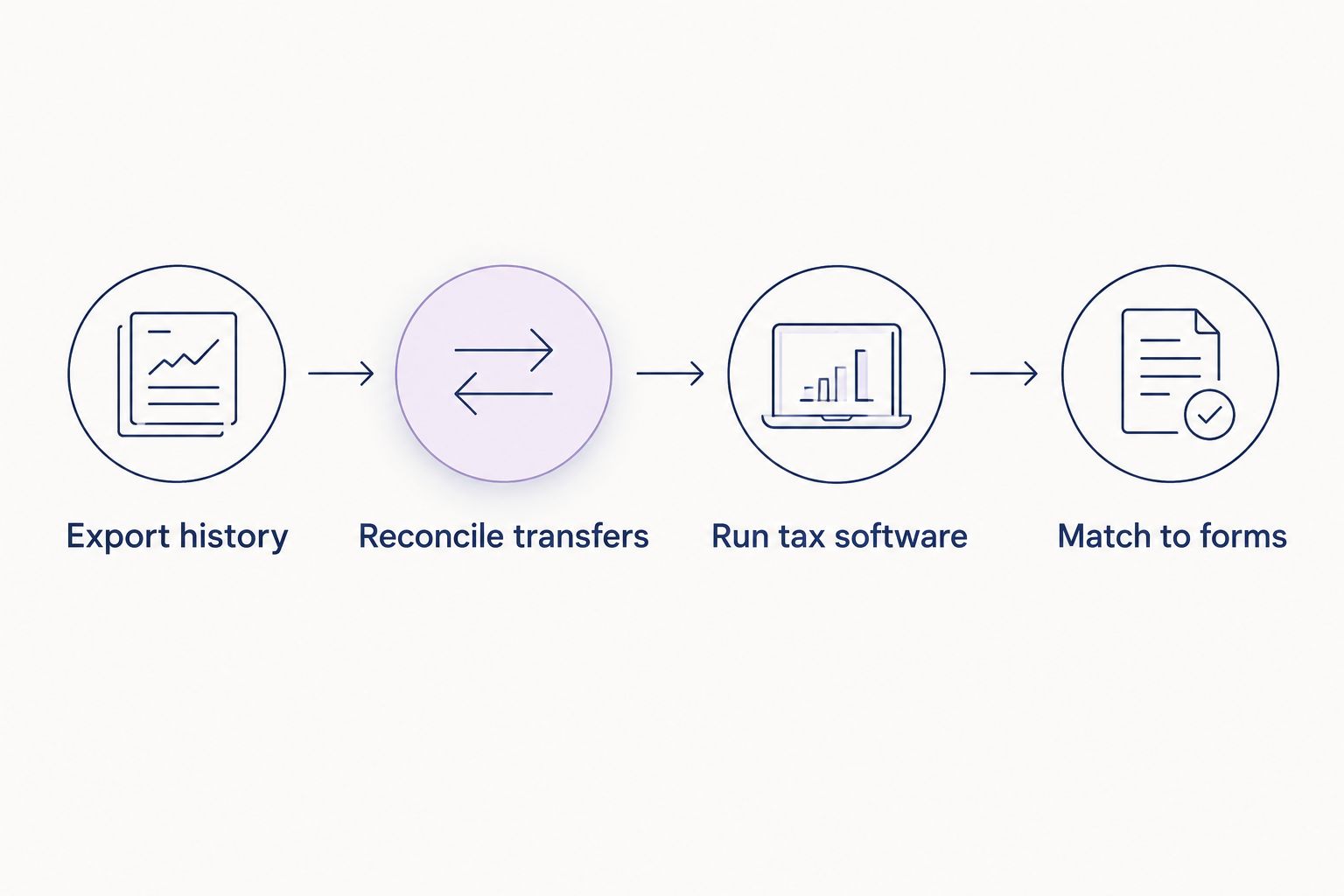
Instead of manually reconciling Coinbase trades against memory every April, build a repeatable pipeline: export complete history, reconcile transfers across every wallet you touch, run it through tax software built for crypto, then match the output against actual IRS forms before you file. Elevated Tax Strategies sees the same three mistakes on almost every crypto return that walks in already filed wrong — this workflow catches them before the IRS does.
- A coinbase crypto tax filing workflow starts with a complete transaction export, not the 1099-MISC alone.
- Coinbase's 1099-MISC only covers rewards over $600 — it ignores capital gains, losses, and transfers entirely.
- Wallet-to-wallet transfers are not taxable events, but most software flags them as sales if you skip reconciliation.
- Short-term crypto gains are taxed as ordinary income up to 37% in 2026; long-term gains top out at 20%.
- Run the reconciled data through dedicated crypto tax software before it ever reaches Form 8949 or Schedule D.
Why this matters
The IRS added a yes/no digital asset question to the front page of Form 1040 years ago and has been tightening broker reporting since. Coinbase now issues 1099-MISC forms for staking and reward income over $600, but that document says nothing about your trading gains, your losses, or what happened when you moved coins to a hardware wallet.
File off the 1099-MISC alone and you've reported a slice of your activity while ignoring the capital gains and losses that actually move your tax bill. Underreport and get matched against an IRS data pull two years from now, and you're paying penalties plus interest on top of the original tax. The workflow below closes that gap before the return goes out.
Before you start
- Coinbase account access with full history — you need transaction-level data going back to your first deposit, not just the current tax year. Partial-year exports miss cost basis on coins you're selling this year but bought two years ago.
- A list of every other wallet and exchange you've touched — hardware wallets, DeFi protocols, other exchanges. If Coinbase is one of three places you've held crypto, this workflow only works when you feed it all three.
- The gotcha: Coinbase's own 1099-MISC does not include capital gains or losses. Treating it as your full tax document is the single most common error crypto filers make, and it's why so many returns get amended a year later.
Set up your transaction export
- Log into Coinbase and go to Taxes & Reports under your account settings.
- Select the generate report option and pull a complete transaction history CSV, not just the current tax year — cost basis calculations need everything.
- Download any 1099-MISC or 1099-DA issued for the year separately; these arrive as PDF documents, not part of the CSV export.
- If you use Coinbase Wallet (the separate self-custody app) in addition to Coinbase's exchange, export that history too — it does not merge automatically with your exchange data.
Expected result: you should have one full transaction CSV covering every year you've held crypto on the platform, plus any 1099 forms issued for the current tax year.
Reconcile transfers between wallets and exchanges
- Sort your export by transaction type and isolate every send and receive entry — these are transfers, not sales.
- Cross-reference each transfer against the receiving wallet or exchange's own records. A coin sent from Coinbase to a hardware wallet needs to show up as a matching receipt on the other side.
- Flag any transfer where the cost basis didn't carry over. This happens constantly when coins move between platforms that don't share basis data automatically.
- Note the original purchase date and price for every transferred coin — you'll need this for the holding period calculation later.
Expected result: every transfer is matched to its destination with cost basis intact, and nothing gets miscounted as a taxable sale.
Run the report through crypto tax software
- Import the reconciled Coinbase CSV, plus any other exchange or wallet exports, into a dedicated crypto tax software platform rather than general tax prep tools.
- Set the cost basis method — FIFO is the IRS default absent a specific election, and switching methods mid-year without documentation invites questions.
- Review the software's auto-generated gain/loss summary line by line against your own transaction count. If the line count doesn't roughly match your trade volume, transfers are being miscategorized.
- Export the finished Form 8949 and Schedule D attachments once the numbers reconcile.
Expected result: a Form 8949 that reflects actual sales and dispositions only, with cost basis and holding period correct on every line.
Match the output to your actual tax forms
- Compare the software's total gain/loss figure against what will land on Schedule D of your 1040.
- Check that any 1099-MISC reward income is reported as ordinary income on Schedule 1, separate from the capital gains on Schedule D — these are two different tax treatments and mixing them understates or overstates your bill.
- If you're self-employed and mining or staking as a business rather than a hobby, that income may belong on Schedule C instead — a different form with different rules on deductions.
- File Form 8949 with your return, attaching the full transaction detail if you're not using the IRS's summary reporting exception.
Expected result: capital gains, ordinary reward income, and any business-related crypto activity land on the correct forms, not lumped together.
If you also have staking, mining, or NFT income
This is the second workflow that piggybacks on the same export. Staking rewards and mined coins are taxed as ordinary income at fair market value the moment you receive them — that's a separate event from what happens when you later sell those coins.
- Pull the fair-market-value log for every staking or mining reward from your export, dated to the day received.
- Report that value as ordinary income for the year received, regardless of whether you've sold the coins yet.
- When you eventually sell, calculate the new gain or loss using that reward value as your cost basis — not zero, and not the original coin price you might be thinking of.
- For NFTs, treat minting and buying as separate cost-basis events from any later sale, and watch for the higher collectibles rate that can apply to certain NFT gains held long-term.
Skip step three and you'll pay tax twice on the same value — once as ordinary income at receipt, once again as a phantom gain at sale with a $0 basis. That single mistake inflates a crypto tax bill more than almost anything else in this workflow.
“If your only crypto document is a 1099-MISC, you haven't filed your crypto taxes — you've filed a fraction of them.”
Troubleshooting
- Cost basis shows as zero on transferred coins. The receiving platform never got basis data from the sending platform. Pull the original purchase record manually and enter it as an adjustment before running the final report.
- Software flags a wallet transfer as a taxable sale. This happens when the send and receive addresses aren't matched during reconciliation. Go back to the reconciliation step and confirm every transfer has a corresponding receipt.
- 1099-MISC amount doesn't match your own reward ledger. Coinbase's reporting can lag or miss rewards under certain thresholds. Use your own transaction log as the source of truth and note the discrepancy if you're asked about it.
- Form 8949 has more lines than your filing software can import directly. High-volume traders often exceed the line limits on consumer tax software. Use the IRS summary reporting option with attached transaction detail instead of forcing every line into the form.
- Total gains look wrong compared to your gut sense of the year. Check whether stablecoin swaps or wrapped-token conversions are being counted as taxable dispositions — depending on the transaction type, some of these trigger gain recognition even though it doesn't feel like a sale.
Customize your workflow
High-frequency traders and anyone mining at scale need a deeper strategy layer than a single filing season workflow — cost basis method elections, entity structuring for mining operations, and timing sales around the 12-month long-term threshold all change the outcome. The crypto tax strategy guide for traders and miners covers that layer.
If you've been filing crypto through consumer software and getting numbers that don't match what a professional would calculate, it's worth seeing where the gap is before your 2026 return goes out.
Get your crypto filing reviewed
See where a DIY crypto tax report missed gains, losses, or basis.
FAQ
Does Coinbase report crypto transactions to the IRS?
Yes. Coinbase issues 1099-MISC forms for staking and reward income over $600 and is expanding broker-style reporting under new IRS digital asset rules. That reporting still doesn't cover your capital gains and losses — you have to calculate those yourself.
How do I get a full tax report from Coinbase?
Go to Taxes & Reports in your Coinbase account settings and generate a complete transaction history CSV covering every year you've held crypto, not just the current tax year. The 1099-MISC alone is not a full tax report.
Is transferring crypto between my own wallets taxable?
No. Moving coins between wallets or exchanges you control is not a taxable event, but many tax software tools flag it as a sale unless the transfer is manually reconciled and matched to its destination.
What cost basis method does Coinbase use?
Coinbase generally defaults to FIFO (first in, first out) for cost basis unless you specify otherwise in your tax software. FIFO is also the IRS default absent a documented election for a different method.
Do I need to report crypto on my taxes if I only lost money?
Yes. Losses still have to be reported on Form 8949 and Schedule D, and reported losses can offset other capital gains or up to $3,000 of ordinary income per year.
What happens if I don't report Coinbase transactions?
The IRS can match unreported transactions against 1099 data Coinbase files directly, which triggers a notice with penalties and interest on top of the original tax owed. Amending before the IRS catches it is far cheaper than waiting for a notice.
Can I just file my Coinbase 1099-MISC and skip the rest?
No. The 1099-MISC only reports staking and reward income over $600 — it excludes trading gains, losses, and any activity on other wallets or exchanges. Filing off it alone means an incomplete return.
How much tax will I owe on crypto gains in 2026?
Short-term gains (assets held under 12 months) are taxed as ordinary income up to 37% in 2026. Long-term gains on assets held over 12 months top out at 20%, plus a potential 3.8% net investment income tax depending on total income.
One last thing
The reward-income-then-sale double count — paying ordinary tax on a staking reward at receipt, then paying tax again on the full sale value with a $0 basis — shows up on more DIY crypto returns than any other single error in this workflow. Fix the basis at receipt and it never happens twice.