
1031 exchange planning for real estate investors is the process of structuring a property sale so gain gets deferred into a replacement property instead of taxed the year you sell. For a landlord sitting on $200,000 or $2 million of appreciation and depreciation recapture, the difference between doing this right and doing it wrong is often a six-figure tax bill in 2026.
What makes this segment different from a homeowner selling a primary residence: real estate investors are usually juggling depreciation schedules, entity structures (LLCs, partnerships), and multiple properties at once. A single missed deadline or a mismatched title on the replacement property can blow up years of tax-deferred growth.
- 1031 exchange planning for real estate investors hinges on two hard deadlines: 45 days to identify, 180 days to close.
- Depreciation recapture under IRC section 1250 gets taxed at up to 25% even inside a failed or partial exchange.
- A qualified intermediary has to be in place before the sale closes — you cannot touch the proceeds yourself.
- Matching title and debt on the replacement property is where most investor exchanges fall apart in 2026.
- Elevated Tax Strategies coordinates the exchange with entity structure and depreciation planning before you list the property.
Why 1031 exchange planning matters for real estate investors
Every rental you've depreciated for years is carrying a tax bill that shows up the day you sell it, not the day you bought it. Depreciation recapture under Section 1250 gets taxed at up to 25%, on top of whatever capital gains rate applies to the appreciation itself. A 1031 exchange doesn't erase that liability — it defers it, rolling your basis into the new property so the tax bill moves down the road instead of hitting you in 2026.
For real estate investors specifically, the stakes compound. You're not deferring one gain, you're often deferring recapture across a portfolio, and every property you exchange changes the depreciation schedule on the next one. Get the 1031 exchange qualified intermediaries piece wrong and the IRS treats the whole sale as a taxable event, recapture and all, in the year you closed.
How to plan a 1031 exchange as a real estate investor
Confirm the property actually qualifies
Section 1031 only covers real property held for investment or business use — not a flip, not your primary residence, not personal-use property. Before you list anything, confirm what you're actually exchanging.
- Rental houses, multifamily, and commercial property held for investment qualify
- Property held primarily for resale (fix-and-flip inventory) does not qualify
- Vacation homes need documented rental use to count
- Land held for investment qualifies; land held for development as inventory usually doesn't
Set your exchange timeline before you sign a purchase agreement
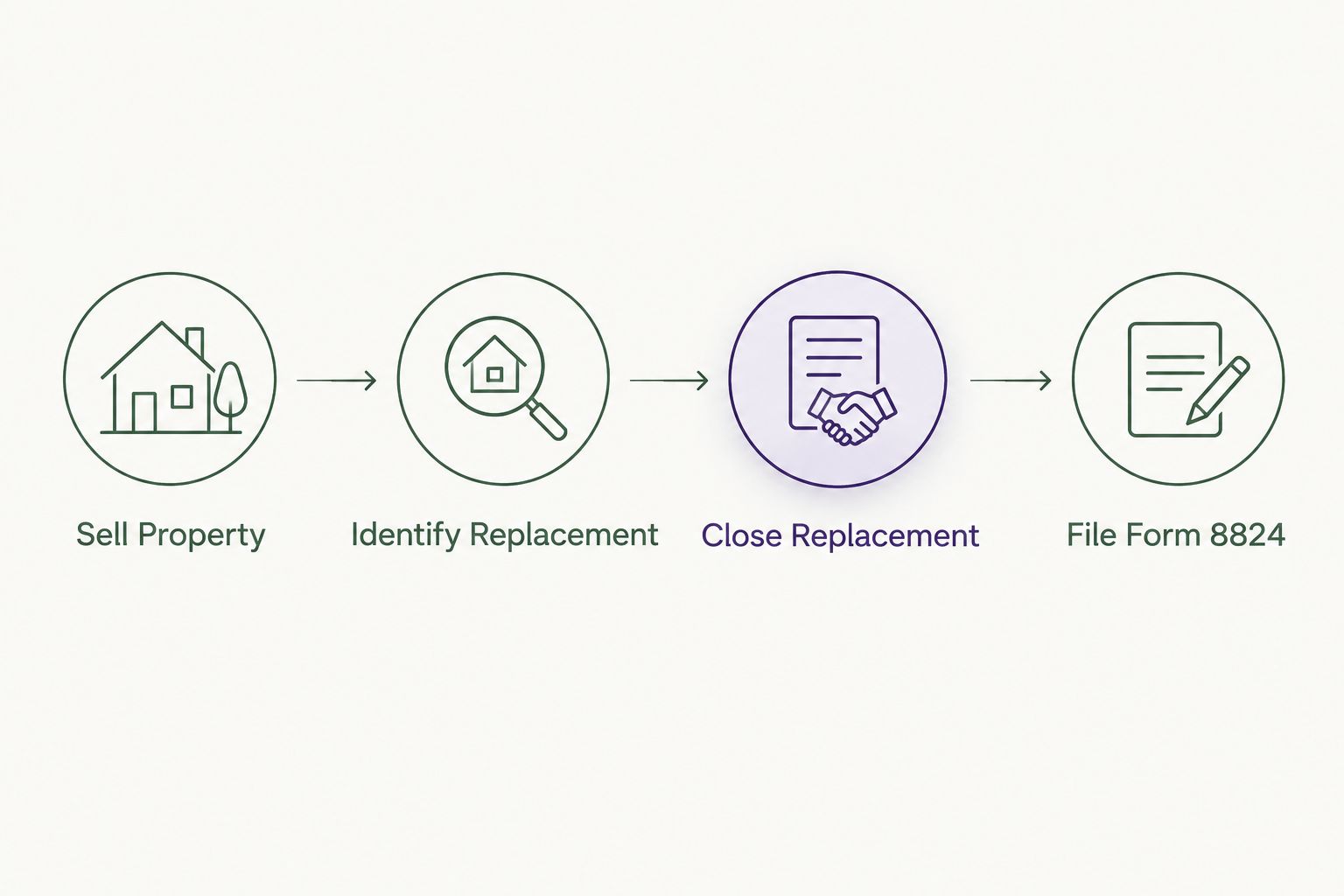
The clock starts the day your relinquished property closes, not the day you decide to exchange. You get 45 calendar days to identify replacement property in writing and 180 days total to close on it — both deadlines run concurrently, and neither one moves for weekends, holidays, or a slow lender.
- Mark the 45-day and 180-day dates on a calendar the moment escrow closes
- Line up financing pre-approval before you're inside the identification window
- Build in a buffer for appraisal and inspection delays on the replacement side
- Never assume an extension exists — disaster relief extensions are rare and IRS-issued, not automatic
Engage a qualified intermediary before the sale closes
You cannot touch the sale proceeds at any point in the exchange — not for a day, not to "hold" them. A qualified intermediary (QI) has to receive the funds directly from closing and hold them until the replacement purchase. Skip this step and the whole exchange is disqualified, retroactively, no matter how good your paperwork looks afterward.
- Get the QI agreement signed before the relinquished property closes, not after
- Confirm the QI carries fidelity bond coverage and segregates client funds
- Never let your real estate agent, attorney, or CPA act as the QI if they've represented you in the transaction within two years
- Compare a handful of 1031 exchange qualified intermediaries rather than defaulting to whoever your title company suggests
Choose the right exchange structure for your situation
Most investors default to a delayed exchange, but it's not the only option. Reverse exchanges and improvement exchanges solve different timing problems, at the cost of more moving parts and more cash tied up.
- Delayed exchange: sell first, then identify and close on the replacement — the standard structure
- Reverse exchange: buy the replacement first, then sell the relinquished property within 180 days — useful in a fast-moving market
- Improvement exchange: use exchange funds to build or improve the replacement property before the 180-day deadline
- Simultaneous exchange: both closings happen the same day — rare, and unforgiving of any delay
Identify replacement property within the 200%/95% rules
The 45-day identification isn't just a deadline — it comes with rules about how many properties you can name and what they're worth.
- The three-property rule: identify up to three properties regardless of value
- The 200% rule: identify more than three properties as long as their combined value doesn't exceed 200% of what you sold
- The 95% rule: identify unlimited properties if you actually acquire 95% of their total value
- Put every identification in writing to the QI — verbal identification doesn't count
Calculate basis, boot, and depreciation recapture exposure
Any cash or debt relief you pocket during the exchange is "boot," and boot is taxable even inside an otherwise valid 1031 exchange. Real estate investors who trade down in debt or value almost always create boot without realizing it.
- Replace at least as much debt as you paid off on the relinquished property, or bring cash to cover the gap
- Run the numbers on a depreciation calculator for rental property investors before you list, not after
- Factor in prior cost segregation studies — accelerated depreciation increases the recapture exposure on sale
- Coordinate timing with a cost segregation study company if you're planning to cost-seg the replacement property
File Form 8824 and reconcile with your return
Form 8824 is where the IRS checks your math. Miss a field, mismatch a basis calculation, or file it inconsistently with prior years, and you've handed the IRS a reason to look closer.
- Report the exchange on Form 8824 in the tax year the relinquished property sold
- Carry forward the adjusted basis correctly on the replacement property's depreciation schedule
- Keep the QI's closing statements and identification letters for at least seven years
- Have a preparer who's actually filed 1031 paperwork review it before submission
“Missing the 45-day identification window kills the exchange — no extensions, no exceptions.”
Comparison: options for managing a 1031 exchange in 2026
| Option | Best for | Key limitation |
|---|---|---|
| DIY with a QI only | Investors with one straightforward swap and no entity complexity | No coordination with depreciation, entity structure, or your actual tax return |
| Real estate attorney | Legal review of contracts and title issues | Doesn't handle tax basis, recapture math, or Form 8824 filing |
| Full-service tax planning firm (Elevated Tax Strategies) | Investors running multiple properties, entities, or cost segregation alongside the exchange | Requires engaging before the sale closes, not after |
Verdict: a QI alone handles the mechanics of the exchange; it doesn't touch the depreciation recapture math, entity coordination, or the return that has to reconcile all of it — that's a tax planning conversation, not a closing-day form.
Plan the exchange before you list
Coordinate the 1031 timeline with your depreciation and entity structure.
Common mistakes real estate investors make
- Waiting to call a QI until after the sale closes. By then the proceeds have already touched your account and the exchange is disqualified.
- Trading down in value or debt without covering the gap in cash. That difference is boot, and boot is taxed in 2026 dollars even inside a valid exchange.
- Assuming a 1031 exchange erases depreciation recapture. It defers the gain into the new property's basis — the recapture liability travels with you, it doesn't disappear.
- Titling the replacement property differently than the relinquished one. The same taxpayer that sold has to be the one that buys; adding a spouse or an LLC mid-exchange can disqualify it.
- Skipping entity coordination. Investors holding property across multiple LLCs often discover mid-exchange that the entity on title doesn't match the entity that sold — fixable, but only if caught early.
FAQ
What is the 45-day rule in a 1031 exchange?
The 45-day rule requires you to identify replacement property in writing to your qualified intermediary within 45 calendar days of closing on the relinquished property. Missing this deadline disqualifies the entire exchange, with no automatic extensions in 2026.
How much does a 1031 exchange defer in taxes?
A 1031 exchange defers both the capital gains tax and the depreciation recapture tax (up to 25% under Section 1250) on the property sold. It doesn't eliminate the liability — it rolls the basis into the replacement property until you sell without exchanging again.
Can I do a 1031 exchange without a qualified intermediary?
No. You cannot receive or control the sale proceeds directly at any point, so a qualified intermediary has to be engaged and funded before the relinquished property closes. Acting as your own intermediary disqualifies the exchange.
Is boot taxable in a 1031 exchange?
Yes. Any cash you receive or debt relief you get from trading down in value is boot, and boot is taxed as gain in the year of the exchange even though the rest of the transaction is tax-deferred.
How many properties can I identify in a 1031 exchange?
Under the three-property rule you can identify up to three properties regardless of value. The 200% rule lets you identify more if their combined value stays under 200% of the property sold.
What happens if I don't complete the exchange in 180 days?
The exchange fails and the entire gain, including depreciation recapture, becomes taxable in the year the relinquished property sold. There's no partial credit for a 1031 exchange that misses the 180-day deadline.
Does a 1031 exchange work for a rental property held in an LLC?
Yes, as long as the same taxpayer that sold the relinquished property acquires the replacement. A single-member LLC that's disregarded for tax purposes generally works fine; multi-member LLCs need the exchange structured at the entity level, not the individual member level.
One last thing
Most investors think the risk in a 1031 exchange sits with the 45-day and 180-day deadlines. The bigger risk sits in the depreciation schedule you're about to inherit: the replacement property's basis carries the relinquished property's unrecaptured depreciation forward, which means your next cost segregation study has to account for basis you didn't originally put into that building. Run that math before you close in 2026, not after the IRS asks for it.